
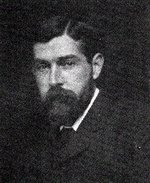
 Francis Herbert Bradley (1846-1924).
He was born at Clapham, Surrey, England. He was the child of Charles Bradley, an Evangelical preacher, and his second wife, Emma Linton. In 1865, he entered University College, Oxford.
He was a member of the movement known as British idealism and famous for his pluralistic approach to philosophy. His pluralistic outlook saw a unity transcending divisions between the philosophy of ethics, history, logic, epistemology, metaphysics and psychology.
One of Bradley’s notable characteristics, in his writing, is his technique of arguing from the meaning of a word. In his concern with word meanings he might be seen as anticipating the more language-orientated philosophy of the 20th century.
Table of Contents
Major Works of Francis Herbert Bradley
– The Principles of Logic, 1883 (The second, revised 1922 edition adds extensive commentary and terminal essays to the text of the first.)
– Appearance and Reality, London: Swan Sonnenschein, 1893 (The second 1897 edition contains a substantial and important Appendix. The most commonly encountered version now is the so-called ‘ninth impression’ of 1930, on which all subsequent printings have been based.)
– Essays on Truth and Reality, 1914 (Mostly published in Mind from 1899 onwards, these are major essays containing developments of Bradley’s logic and metaphysics, incisive criticism of William James and Bertrand Russell, and reflections on religion.)
– Ethical Studies (1927)
– Aphorisms, 1930 (The modern edition is bound together with ‘The Presuppositions of Critical History’ and contains an introduction to the latter by Guy Stock.)
Videos

Essays on truth and reality (1914). F. H Bradley: Francis Herbert Bradley OM (30 January 1846 – 18 September 1924) was a British idealist ... work was Appearance and Reality (1893).
- Bradley, F. H (Author)
- English (Publication Language)
- 262 Pages - 02/11/2017 (Publication Date) - CreateSpace Independent Publishing Platform (Publisher)

Ethical Studies
- Amazon Kindle Edition
- Francis Herbert Bradley (Author)
- English (Publication Language)
- 445 Pages - 06/14/2018 (Publication Date) - HardPress (Publisher)

Ethical Studies (1876). By: F. H. Bradley: Francis Herbert Bradley OM (30 January 1846 – 18 September 1924) was a British idealist philosopher.
- Bradley, F. H. (Author)
- English (Publication Language)
- 192 Pages - 11/06/2017 (Publication Date) - CreateSpace Independent Publishing Platform (Publisher)

Appearance and reality : a metaphysical essay
- Amazon Kindle Edition
- Bradley, Francis Herbert (Author)
- English (Publication Language)
- 588 Pages - 02/09/2014 (Publication Date)

Appearance and Reality: A Metaphysical Essay by Francis Herbert Bradley (2003-01-22)
- 04/19/1667 (Publication Date) - Adamant Media Corporation (Publisher)

Appearance and Reality: A Metaphysical Essay - Scholar's Choice Edition
- Bradley, Francis Herbert (Author)
- English (Publication Language)
- 656 Pages - 02/08/2015 (Publication Date) - Scholar's Choice (Publisher)

Essays on truth and reality
- Amazon Kindle Edition
- Bradley, Francis Herbert (Author)
- English (Publication Language)
- 01/07/2020 (Publication Date)

Die Erkenntnis- und Realitätsproblematik bei Francis Herbert Bradley und Bernard Bosanquet (Epistemata) (German Edition)
- Moser, Claudia (Author)
- German (Publication Language)
- 248 Pages - 04/19/1989 (Publication Date) - Königshausen & Neumann (Publisher)

TEN UNPUBLISHED LETTERS FROM WILLIAM JAMES 1842 - 1910 TO FRANCIS HERBERT BRADLEY 1846-1924 - contained in single complete issue of MIND for JULY 1966)
- Kenna, J C (William James) (Author)
- 01/01/1966 (Publication Date) - See Description (Publisher)

The Legacy of William Carlos Williams: Points of Contact
- Hardcover Book
- Ian Copestake (Author)
- English (Publication Language)
- 220 Pages - 06/01/2007 (Publication Date) - Cambridge Scholars Publishing (Publisher)
Last update 2020-06-17. Price and product availability may change.