
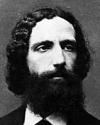
 Franz Clemens Brentano (1838-1917).
Franz Brentano studied philosophy at the universities of Munich, Würzburg, Berlin (with Trendelenburg) and Münster. He had a special interest in Aristotle and scholastic philosophy. He wrote his dissertation in Tübingen On the manifold sense of Being in Aristotle.
Subsequently he began to study theology and entered the seminar in Munich and then Würzburg, preparing to become a Roman Catholic priest (ordained August 6, 1864). In 1865 – 1866 he writes and defends his habilitation essay and theses and begins to lecture at the university of Würzburg. His students in this period include among others Carl Stumpf and Anton Marty.
Between 1870 and 1873 Brentano is heavily involved in the debate on papal infallibility. As strong opponent of such a dogma, he eventually gives up his priesthood. Following his religious struggles, also Stumpf (who was studying at the seminar at the time) is drawn away from the church.
In 1874 he publishes his major work: “Psychology from an empirical standpoint” and from 1874 to 1895 he teaches at the university of Vienna. Among his students are Edmund Husserl, Alexius Meinong, Christian von Ehrenfels and many others (see School of Brentano for more details). While beginning his career as a full ordinary professor, he is forced to give up his Austrian citizenship and his professorship in 1880 to be able to marry. He is permitted to return to the university only as a Privatdozent.
After his retirement he moves to Florence in Italy and at the outbreak of the First World War he transfers to Zürich, where he dies in 1917.
Table of Contents
Major Works of Franz Brentano
– On the Several Senses of Being in Aristotle, 1862 (Brentano’s Berlin doctoral dissertation: a catalogue of the ways Aristotle says something may be said to be; includes a classification and justification of the categories.)
– Psychology from an Empirical Standpoint, 1874 (Brentano’s best-known and most influential work, though incomplete. Contains a defence of psychology as an autonomous discipline, the famous delimitation of its subject matter, mental phenomena, via intentional existence, and a threefold classification of mental phenomena into ideas, judgments, and phenomena of love and hate (interests), which include both feeling and will.)
– The Origin of our Knowledge of Right and Wrong, 1889 (Brentano’s ethics in a small compass, based on a theory of intrinsic value defined in terms of correct interests and preferences, supplemented by a utilitarian account of instrumental value.)
– The Four Phases of Philosophy and tts Present Status, 1926 (Brentano’s theory of the cyclical rise and decline of philosophy.)
– On the Existence of God, 1929 (Posthumously published treatise setting oat Brentano’s probabilistic proof for the existence of God.)
– The True and the Evident, 1930 (A chronologically arranged series of writings on truth, beginning with Brentano’s somewhat half-hearted espousal of a correspondence theory and ending with its rejection in favor of the view that a true (correct) judgment is one which someone judging with evidence would accept.)
– The Theory of Categories, 1933 (A miscellaneous collection of late writings on categories and ontology, setting out Breutano’s opposition to Aristotle and his economical ontology of reism. Discusses meanings of ‘be’, substance and accident, relations and linguistic fictions.)
– The Foundation ant! Construction of Ethics, 1952 (Compiled from the notes Brentano made for his enormously popular lectures on practical philosophy in Vienna, 1876-94.)
– Philosophical Investigations on Space, Time, and the Continuum, 1976 (Subject matter as the title describes: contains Brentano’s account of time-consciousness, his anti-Cantorian theory of the continuum and his unorthodox views on boundaries.)
– Descriptive Psychology, 1982 (Edited from Vienna lecture notes: psychology from Brentano’s influential middle period, when he had distinguished descriptive psychology (phenomenology) from genetic psychology.)
Videos

Psychology from An Empirical Standpoint (Routledge Classics)
- Brentano, Franz (Author)
- English (Publication Language)
- 452 Pages - 09/11/2014 (Publication Date) - Routledge (Publisher)

Philosophical investigations on space, time, and the continuum
- Hardcover Book
- Franz Brentano (Author)
- English (Publication Language)
- 202 Pages - 04/24/1988 (Publication Date) - Croom Helm (Publisher)

The Cambridge Companion to Brentano (Cambridge Companions to Philosophy)
- English (Publication Language)
- 344 Pages - 02/09/2004 (Publication Date) - Cambridge University Press (Publisher)

The Origin of Our Knowledge of Right and Wrong: With a Biographical Note
- Brentano, Franz Clemens (Author)
- English (Publication Language)
- 180 Pages - 08/20/2001 (Publication Date) - Adamant Media Corporation (Publisher)

On the several senses of being in Aristotle
- Hardcover Book
- Brentano, Franz Clemens (Author)
- English (Publication Language)
- 197 Pages - 04/24/1975 (Publication Date) - University of California Press (Publisher)

Aristotle and His World View
- Hardcover Book
- Brentano, Franz Clemens (Author)
- English (Publication Language)
- 138 Pages - 04/01/1978 (Publication Date) - Univ of California Pr (Publisher)

The Routledge Handbook of Franz Brentano and the Brentano School
- English (Publication Language)
- 408 Pages - 12/10/2019 (Publication Date) - Routledge (Publisher)

Brentano's Mind
- Hardcover Book
- Textor, Mark (Author)
- English (Publication Language)
- 256 Pages - 10/17/2017 (Publication Date) - Oxford University Press (Publisher)

Psychology from an Empirical Standpoint (International Library of Philosophy)
- Brentano, Franz (Author)
- English (Publication Language)
- 448 Pages - 11/21/1995 (Publication Date) - Routledge (Publisher)

Franz Brentano's Analysis of Truth
- Amazon Kindle Edition
- Srzednicki, Jan J.T. (Author)
- English (Publication Language)
- 174 Pages - 12/06/2012 (Publication Date) - Springer (Publisher)
Last update 2020-06-17. Price and product availability may change.