
 George Edward Moore (1873-1958).
George Edward Moore, also known as G.E. Moore, (November 4, 1873 – October 24, 1958) was a distinguished and hugely influential English philosopher who was educated and taught at the University of Cambridge. He was, with Bertrand Russell, Ludwig Wittgenstein, and (before them) Gottlob Frege, one of the founders of the Analytic tradition in philosophy, which now predominates in the English-speaking world.
Moore is best known today for his defense of ethical non-naturalism, his emphasis on common sense in philosophical method, and the paradox which bears his name. He is very much “philosopher’s philosopher”—greatly admired and influential among other philosophers, but (unlike his friend and colleague Russell) mostly unknown today outside of academic philosophy. Moore’s essays are known for his clear, circumspect writing style, and for his methodical and patient approach to philosophical problems. Among his most famous works are his book Principia Ethica, and his essays, “The Refutation of Idealism”, “A Defence of Common Sense”, and “A Proof of the External World”.
G.E. Moore died on October 24, 1958 and was interred in the Burial Ground of Parish of the Ascension, Cambridge, England. The poet Nicholas Moore is his son.
Table of Contents
Major Works of George Edward Moore
– Principia Ethica (1903)
– The Refutation of Idealism (1903)
– Ethics (1912)
– A Defence of Common Sense (1925)
– Some Main Problems of Philosophy (1953)
– Commonplace Book (1962)
Videos
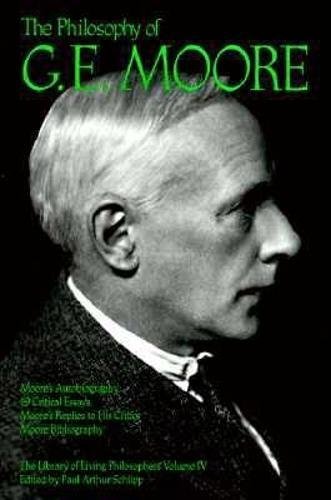
The Philosophy of G. E. Moore, Volume 4 (Library of Living Philosophers)
- Hardcover Book
- Moore, G.E. (Author)
- English (Publication Language)
- 727 Pages - 05/04/1999 (Publication Date) - Open Court (Publisher)

Philosophical Papers (Muirhead Library of Philosophy)
- Moore, George Edward (Author)
- English (Publication Language)
- 326 Pages - 11/01/2010 (Publication Date) - Routledge (Publisher)

Commonplace Book of G.E. Moore, 1919-1953
- Hardcover Book
- MOORE,George Edward (Author)
- English (Publication Language)
- 411 Pages - 04/27/1962 (Publication Date) - see notes for publisher info (Publisher)

A Defense of Realism: Reflections on the Metaphysics of G. E. Moore
- Used Book in Good Condition
- Hardcover Book
- Klemke, E. D. (Author)
- English (Publication Language)
- 466 Pages - 12/01/1999 (Publication Date) - Humanity Books (Publisher)

Principia Ethica
- Moore, G. E. (Author)
- 04/27/1966 (Publication Date) - Cambridge University (Publisher)

Against Absolute Goodness (Oxford Moral Theory)
- Hardcover Book
- Kraut, Richard (Author)
- English (Publication Language)
- 240 Pages - 12/02/2011 (Publication Date) - Oxford University Press (Publisher)

The Photographic Art of Hoyningen-Huene
- Ewing, William A. (Author)
- English (Publication Language)
- 248 Pages - 05/01/1998 (Publication Date) - Thames & Hudson (Publisher)

Blindspots (Clarendon Library of Logic and Philosophy)
- Hardcover Book
- Sorensen, Roy A. (Author)
- English (Publication Language)
- 472 Pages - 06/30/1988 (Publication Date) - Clarendon Press (Publisher)

The Moral Philosophy of G. E. Moore
- Used Book in Good Condition
- Hardcover Book
- Sylvester, Robert (Author)
- English (Publication Language)
- 231 Pages - 05/18/1990 (Publication Date) - Temple University Press (Publisher)

Statesman of Europe: A Life of Sir Edward Grey
- Amazon Kindle Edition
- Otte, T. G. (Author)
- English (Publication Language)
- 752 Pages - 11/05/2020 (Publication Date) - Penguin (Publisher)
Last update 2020-06-17. Price and product availability may change.